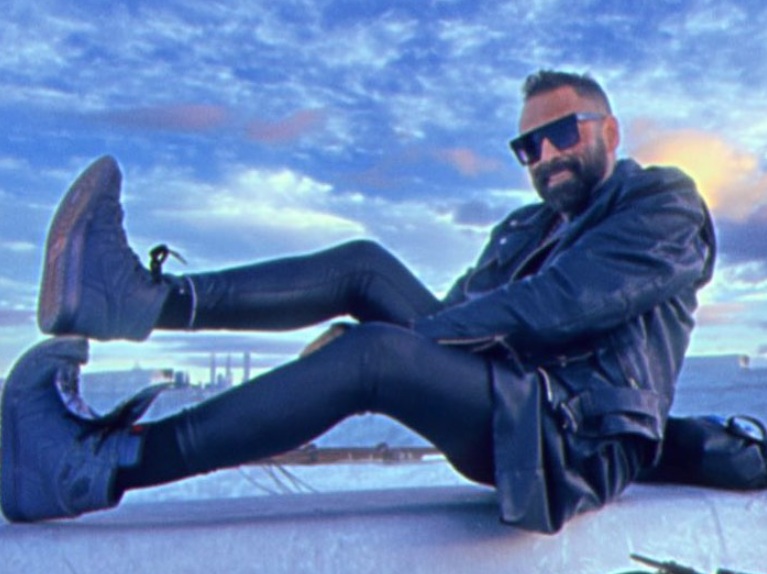
One of the greatest DJs / producers who came up in New York’s most epic era of nightlife and club music, El Salvadorian born and Hawaiian raised George Lopez aka Keoki Franconi has taken us up on a journey to glorious highs.
He’s also weathered some truly dark moments that make up some of the scene’s most notorious cautionary tales. But the beat goes on, and with an exciting new party premiering in Brooklyn this week Keoki is bringing old and new school dancefloor joy back at a time when we all so desperately need it.
Thotyssey: DJ Keoki, hello! Thanks so much for chatting with us! We’re having a wild year as a whole so far, but surely you’ve seen it all by now. What has been keeping you both strong and engaged in 2026?
DJ Keoki: Well, in order not to get depressed–just my music. Everything seems so fucked up in this world… but fucked up things usually inspire me to make music anyway. So I’ve been doing that: writing music, and staying relevant with my DJing.
A quick aside before we get into it: Confessions of a Dance Floor II is on its way! Do you love it already, or might this be Meh-Donna?
I love Madonna. She’s great. There’s no wrong she could do for me. She’s always be the queen.
Yes! You’ve had a legendary career as a DJ that’s seen you spin in some of the most important nightclubs in history, and in festivals and cities all over the world. Was there a moment through all of that which was just so incredible that you couldn’t believe it was happening?
Oh, so many. but I guess one of my favorite ones was Love Parade in Berlin–the first time I went. But I’ve had so many incredible times; my life is incredible. I’m really happy and blessed to have it, and I still have it.
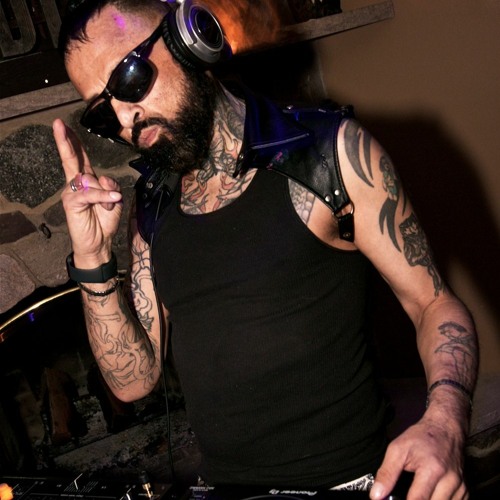
What do you recall was some of the music you first loved as a kid, and how did that evolve over time?
Well, my dad used to collect records, so music was a real big part of my life. The first record I brought home was the Sex Pistols’ Never Mind the Bollocks... but it evolved. I grew up in Hawaii, and I used to read magazines in the Waikiki magazine stands, and I learned all about new wave and punk rock.
I really couldn’t find that much music. There was one store where I could get some of it; I would collect the albums I could get there, put plastic leaves on them, and collect them. Not thinking I’d be a DJ, but just wanted to own them. Bow Wow Wow, Tears for Fears, Missing Persons, Oingo Boingo, The Cure. I remember I wrote “Sex Pistols” on my shirt, tore it up, and wore it to school… and I got sent into the principal’s office because the word “sex” was on my shirt. I tried to explain it was a band, but no one believed me because I didn’t own the record yet. I had just seen it in a magazine.
I understand that you were studying and training to work in the airline industry, which was what brought you to New York. How did that lead to you becoming a DJ?
Well, I went out with some friends from work at New York Air, an airline that no longer exists. We went to a club called Area at 157 Hudson, and I met a busboy there. He was trying to pick me up–and he did, lol. I went back with him, and we became very close. The airline job was only part-time; I was making, I think, $3.50 an hour. So he helped me get a job at Area as a busboy.
While I was working at Area, I met Daddy DJ Johnny Dynell, who was the DJ at the club. He saw my interest in music. I was constantly asking him questions and watching him, and he took me under his wing. One night, the lounge DJ could not make it. I offered to DJ–and they said no, of course. I had never played records in public. DJ Daddy Johnny Dynell knew of my love for music, and he was the main floor DJ. He spoke to the manager, and the manager said “okay, but the lounge better be packed with people drinking at 3am.” My set was from 11pm until 4am, and I was able to do it.
So that led to more gigs, and I eventually quit the airline job–that was a big decision. I knew I made the right one because I loved doing what I was doing, and people liked the music I played which is most important. Technical mixing skills come later with experience. Turntableism, I believe, is the term.
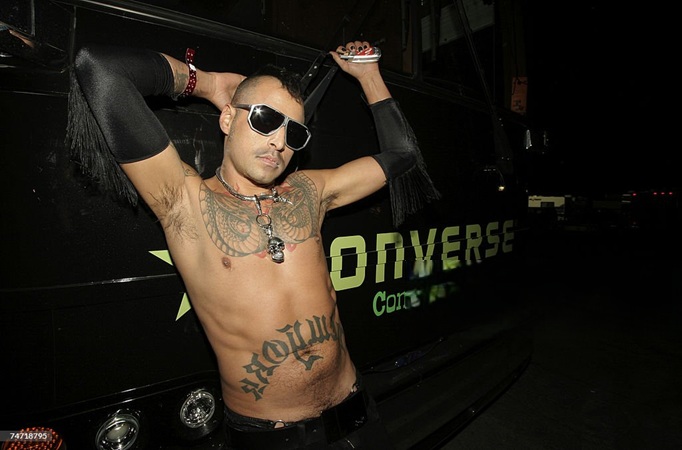
Were all the big clubs and parties that have become such an important chapter of NYC nightlife’s history already happening in that major, famous way when you got there, or did you get to see that all evolve with you?
I was there at the right time… I just didn’t know it at the time. The busboy I met started throwing parties, and I was helping him promote. I was playing at his parties. Of course, we grew together and helped each other out. We got a weekly night at Limelight, which at the time was not doing well. People called it Slimelight. We were doing a weekly party at The It Club on Wednesdays; we moved it to Limelight on Wednesdays, and that party was very successful every Wednesday for six years. It was called Disco 2000. I also had a weekly residency on Thursdays that also ran for six years at an after-hour club called Save the Robots. Both those residencies led to gigs all over the world. Berlin Love Parade in 1995 was my first international gig.
Everyone danced back then! Folks still do today in the right places at the right times, but it’s become a lot more difficult for people to just let loose and live in the moment. Does that make you a little sad and nostalgic when you’re on the dancefloor or in the booth today?
Well, you know, it’s my job to get people to dance and to enjoy themselves. It’s a little harder these days to get people to come out–but once they’re there, I can get them to dance and enjoy themselves. I’ve got over 30 years of DJ experience, and I know I stay relevant DJing and producing music. I believe the power of music can do anything.
DJing is maybe a big popular trend or hobby for some, but I believe it takes years of experience to really be able to create it and truly be an artist. The art of DJing encompasses more than just to simply stand up there and make a room move, and make people jump up and down. Those who don’t jump up and down and fist pump are staring at the DJ with their arms crossed, waiting for him to do some kind of backflip or something. I Remember-going to Sound Factory and not even knowing where the DJ booth was, or even thinking that maybe, possibly, I could get a glimpse of Junior Vazquez. I went because the music was amazing. I knew I was going to lose myself and disappear into the music. Yes, it was Junior DJing… I was just not there to look at him or judge him.
Do you think a baby DJ can get by with fewer curating and technical skills today then someone from your era could, who really had to be an all-knowing sonic wizard? And actually, I’m guessing that as someone who once had to drag around a ton of analog from gig to gig… there must be a lot you do like about modern digital tech in the booth!
Nowadays it seems like anybody can just learn to mix and get their friends to come and fist pump, jump up and down. And of course you have great tools like sync buttons and all kinds of equipment available at your fingertips to be a “DJ,” even a very popular DJ. But truthfully, that does not make you a great DJ or an artist performing the art of DJing. The true art is being able to read the room, gather up everyone’s energy and feel it, and then bring all of their energy together, so they are all in the same space and place.
Sync buttons and all those little gadgets and stuff are great tools to use to become technically very good. It’s like when you are home, or in a car driving with your friends, and someone takes control of the music selection… even if it’s just changing the radio station. You’re DJing, just not in a big room on a stage. You are still the DJ, and it’s up to you to get everybody to enjoy themselves and lose themselves in the music. You are just playing one song after another, and keeping the room happy and in sync. You’ve got people who are fucked up, or not fucked up, or just not happy, or very happy… whatever is going on in their head. You have to bring them all into the same happy place.
It’s not an easy thing to do, especially these days. Everyone is trying to document their experience for social media, and proving to people that they were having the time of their life. But are they really, truly?
You’ve put out tons of mixes and original compositions over the years. Is that process of recording very intentional for you? Do you sit down with specific ideas and just work through them, or do you find yourself just randomly playing around with samples and beats and accidentally creating something great?
Ali of the above. Sometimes things will inspire me, and I’ll just start something. Sometimes there’s no inspiration; I have to wait around for it. But there’s still a schedule, so I gotta put something together. Those are harder to do… but like I said earlier, when times are dark I get inspired and feel very creative.
Who are some of the best DJs of all time, in your opinion?
John Digweed, Sasha, Carl Cox, Erik Elias and Johnny Dynell.
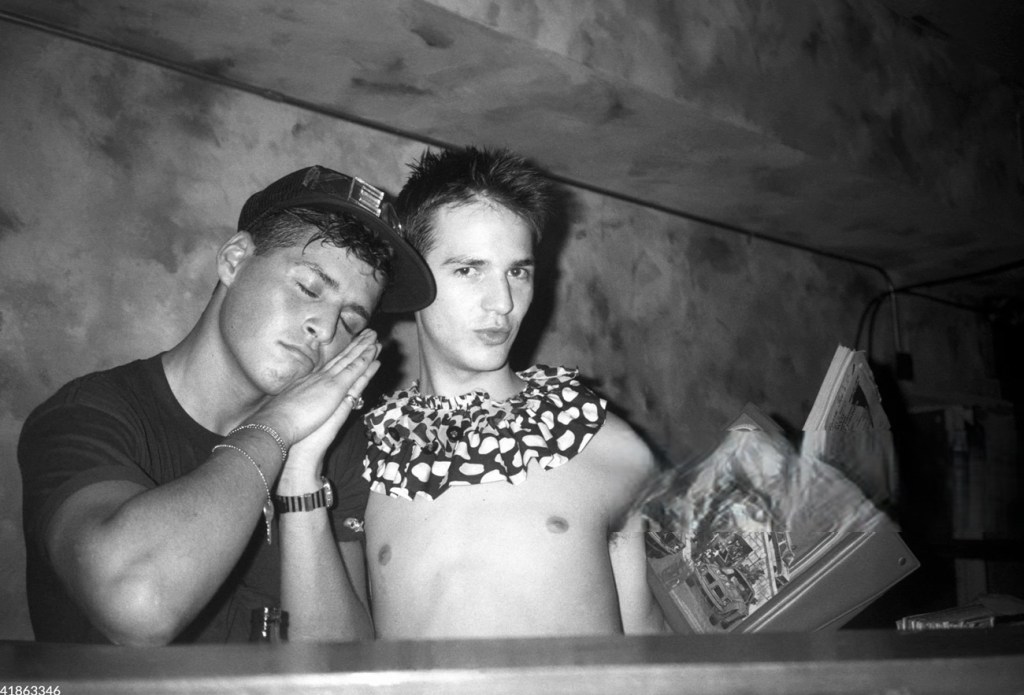
For better or worse, you’ll always be part of the narrative of the Club Kids of the 90s, who created a lot of the fashion-art-music-party scematics that we’re still using in the scene today. That busboy lover you started Disco 2000 with was Michael Alig. Michael was very innovative and talented in that world as a marketer and creative producer, but as he fell deeper into drugs he ultimately wound up in jail for decades after being involved in the brutal murder of fellow nightlifer Andre “Angel” Melendez. Obviously so much media over the years has discussed and exposed details of that crime: Michael Musto’s Village Voice columns, James St. James‘ book, multiple documentaries and a scripted film where Wilmar Valderrama played you. Is that a period of your life that you remember in great detail, or does it all feel like a hazy blur now?
To be honest I like to live in the moment, not the past. Yes, there as lots of really awesome memories I have from that time. There’s no point in being worried about the past or living in the past, or even stressing out about the future. I live in the moment, and try to keep a smile on my face. Those are two things I remind myself of every day. If there’s no smile on my face, it’s usually the environment I’m in, or the people I’m around, so I leave the environment and avoid or move away from people who take my smile away.
It must have been a very emotionally confusing thing when Michael Alig fatally overdosed some time after his prison release. Whether or not you kept in contact with him during that time, you lost a person that was once important to you, yet also the cause of much pain. Is there anything you feel the world or today’s generation needs to understand about Michael, or just that whole scene / time in general, that they might not get from the whole “Party Monster” media machine?
There’s so much that I’d like to say about that, but this really isn’t a place to do that. All I can say is, yes… he was very influential and it was very inspiring to be around at that time with Michael. He was a very complex character and he did influence a lot of people who did some awesome things… and also ended up doing some really messed up things. Once again, I go back to: let’s try to live in the moment and learn from our mistakes, and move forward. That’s what I do.
Another sad thing that happened in your life was that a TV executive fatally OD’d in your home a decade or so ago. I believe that you stepped away from music and DJing for quite awhile after that. How did you find peace and healing during that time, and what ultimately brough you back to music?
I never really left music… I just dove deeper into it. I just didn’t release anything. Lots of things happen to people that are tragic, and some that are great. This was just what was dealt to me, and I deal with music. Music helps me through it all of it; it’s the only thing that’s never let me down.
Do you still heavily lean into the music you came up with in your early DJ days, or do you try to regularly find stuff that’s new–or at least new to you?
All the above. I try to stay relevant; I’m always listening to music. I go out to clubs and listen to music, and I make music in the studio–that’s staying relevant. I surround myself with people who produce music and are involved with music, and that keeps me relevant as well.
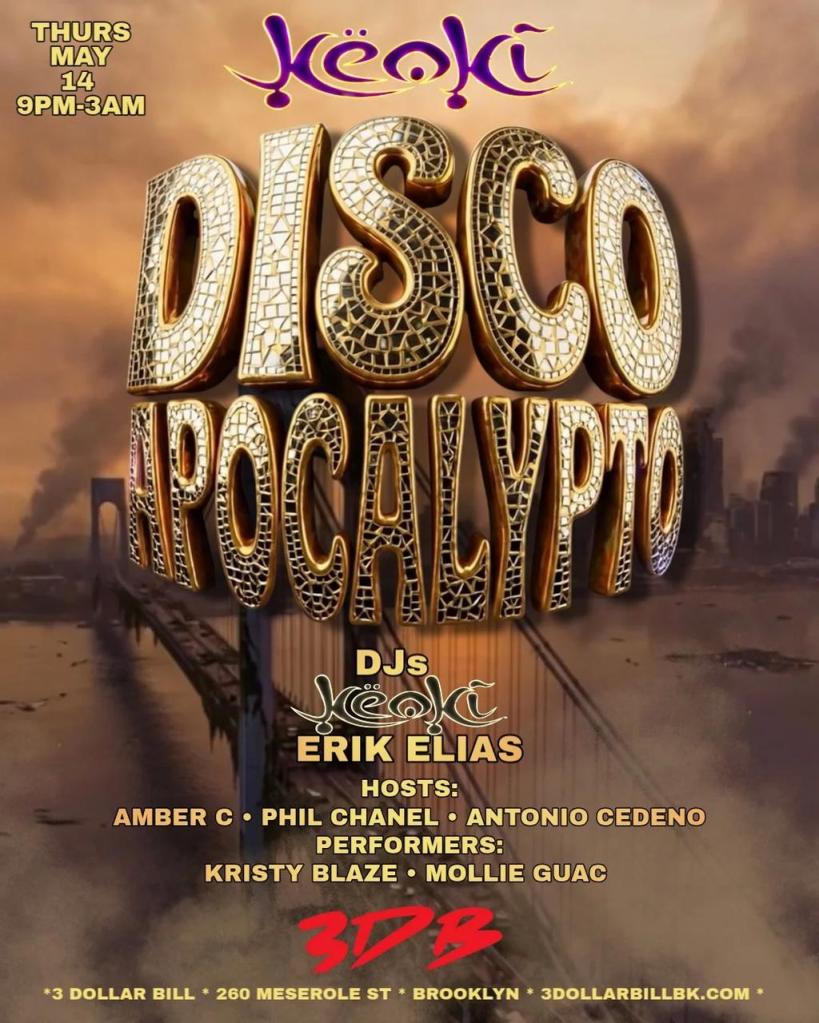
You’re coming back to NYC nightlife in a very fun way on Thursday, May 14th care of “Disco Apocalypto” at 3 Dollar Bill! You and Erik Elias will be in the booth, Mollie Guac and Kristy Blaze will be performing, and the host committee includes Phil Chanel, Amber C and Antonio Cedeno. What’s in store for us as far as far as sounds, vibes, etc. go?
You’ll have to come see what’s up. I’m always keeping things fresh, especially when I’m doing something in New York City. It’s my favorite city in the world, obviously,
What else is coming up for you, or is there anything else you want to mention?
Well, I’ve been focusing my energy on this “Disco Apocalypto” party. I really love playing in New York regularly; hopefully we’ll be able to do these more often and it’ll grow.
It’s important for people to keep hope and faith alive in their lives. Times are tough, and times are weird. Music will always save you–it really, truly will–so come out, check it out. Let’s have some fun. Whether the world ends or not… we wanna have a smile on our face when it happens.
Thanks Keoki! Have fun getting the kids on their feet this Thursday!
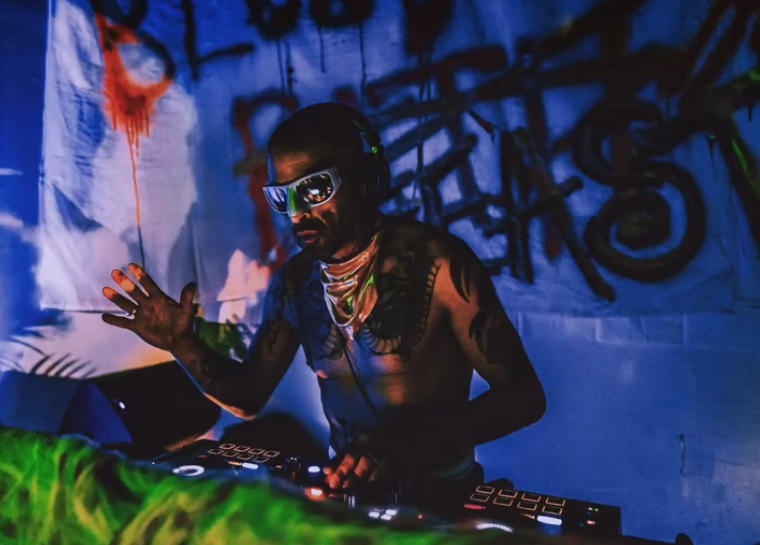
Check Thotyssey’s calendar for DJ Keoki’s upcoming appearances, and follow him on Facebook, Instagram, YouTube and SoundCloud.

